
Understanding I-V Curves for Solar Cell Characterisation
Learn how to read a solar cell's current-voltage curve, extract Voc, Jsc, fill factor, and efficiency, and diagnose device problems from the curve's shape. Includes an interactive series and shunt resistance explorer.
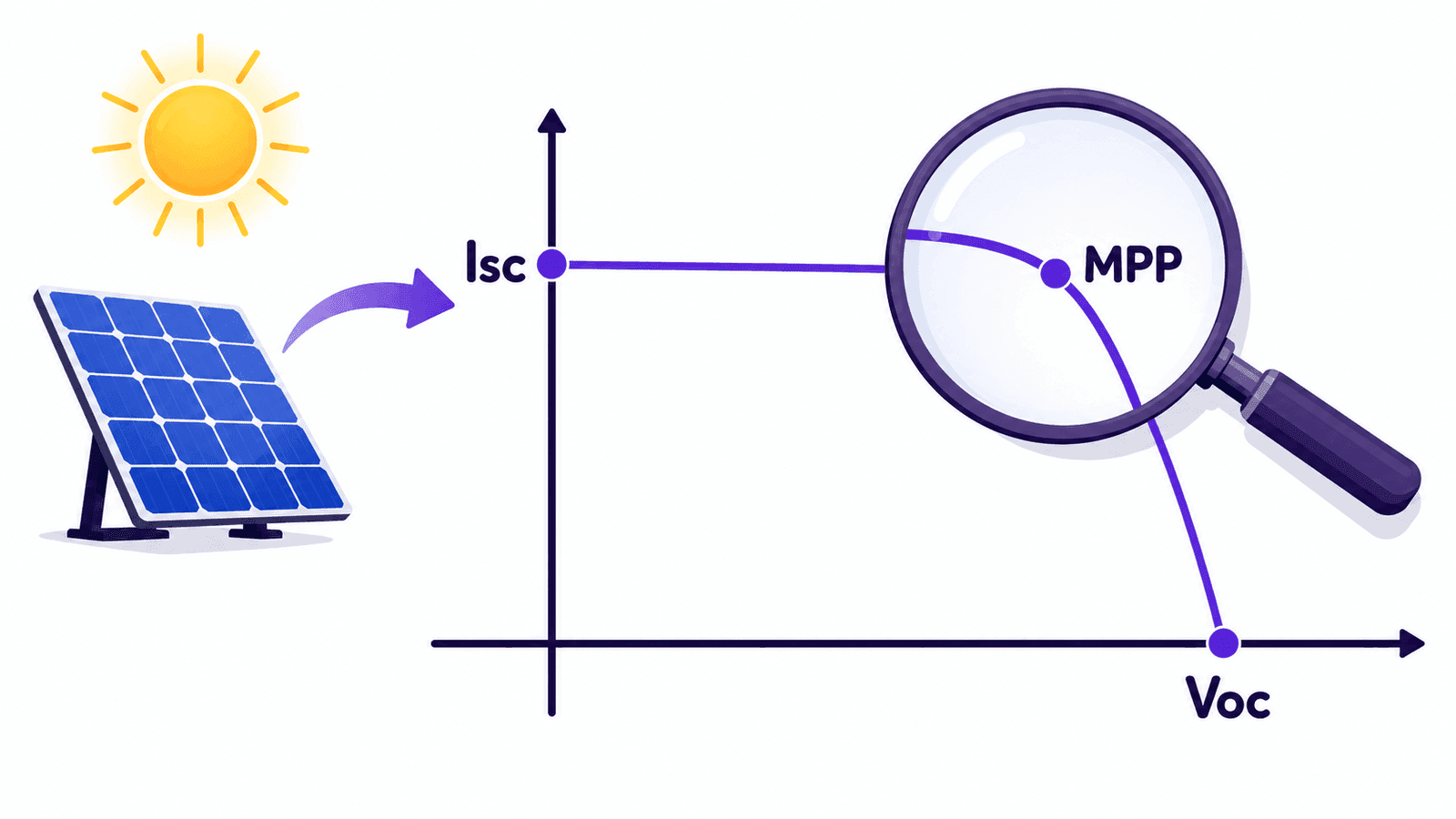
The current-voltage (I-V) curve is the workhorse measurement of photovoltaics. One sweep, taking a few seconds, tells you how much power your solar cell produces, what limits it, and often what went wrong in fabrication. Learning to read these curves fluently is one of the most valuable skills a PV researcher can develop.
TL;DR: A solar cell's I-V curve yields four headline parameters: open-circuit voltage (Voc), short-circuit current (Isc), fill factor (FF), and power conversion efficiency (PCE). The shape of the curve carries just as much information: series resistance rounds off the knee, shunt leakage tilts the flat region. Try the interactive explorer below to build an intuition, and use our free I-V Analysis Tool to extract every parameter from your own data automatically.
What an I-V curve actually is
An I-V measurement is conceptually simple: apply a voltage across the cell, measure the current flowing through it, then step the voltage and repeat. Sweeping from just below 0 V to just beyond the open-circuit voltage traces out the cell's full electrical characteristic under whatever illumination you provide.
In the dark, a solar cell behaves like a large-area diode, and its I-V curve looks like a textbook diode exponential. Under illumination, photogenerated current shifts the whole curve downwards: the cell now produces current over a range of voltages, and that region between 0 V and Voc is where it generates power. If you want the underlying diode equations, PVEducation's I-V curve page has an excellent interactive treatment of this superposition.
Two conventions to be aware of when reading published curves:
- Sign: power generation is often plotted as negative current (the physics convention), but many papers flip the curve so generation appears positive. Both are fine; just check the axes.
- Current vs. current density: research cells of different sizes are compared by dividing current by active area, giving current density (J, usually in mA/cm²). You'll see "J-V curve" and "I-V curve" used almost interchangeably.
One practical note: sweeping through this curve requires an instrument that can both source voltage and sink the current the cell generates. That's why solar cell testing is done with a source-measure unit rather than a bench power supply.
The four headline parameters
Open-circuit voltage (Voc)
Voc is the voltage at which no net current flows: the point where the curve crosses the voltage axis. It's the maximum voltage the cell can produce, and it reflects the quality of the semiconductor and its interfaces. Higher Voc generally indicates:
- A well-matched absorber bandgap and low fundamental losses
- Reduced recombination in the bulk and at surfaces
- Effective passivation and selective contacts
Because recombination depends exponentially on voltage, Voc is exquisitely sensitive to defects. A batch of cells with scattered Voc values usually points to inconsistent surface treatment or contamination.
Short-circuit current (Isc) and current density (Jsc)
Isc is the current at zero applied voltage: the point where the curve crosses the current axis. It's set by how much light the cell absorbs and how efficiently the resulting carriers are collected:
- Light intensity and spectrum
- Active area and optical losses (reflection, shading from contacts)
- Absorption properties of the material
- Carrier collection efficiency
Jsc is Isc divided by the active area, and this division is a notorious source of inflated results. If light enters the cell from outside your defined area, or the area itself is measured optimistically, your Jsc (and therefore your efficiency) reads high. Use a well-defined aperture mask and measure it properly.
The maximum power point and fill factor
Power is voltage times current, and somewhere between Voc and Isc lies the sweet spot: the maximum power point (MPP), with coordinates Vmp and Imp. The fill factor measures how close the curve comes to the ideal rectangle bounded by Voc and Isc:
FF = (Vmp × Imp) / (Voc × Isc)
Geometrically, FF is the ratio of two rectangles: the one you actually get (Vmp × Imp) versus the one you'd get from a perfectly "square" curve (Voc × Isc). The animation below makes this concrete: watch the delivered power grow and collapse as the operating point moves, and where it settles.
A high fill factor means the curve stays flat until late and then drops steeply, so the cell delivers nearly its full current at a useful voltage. Good laboratory cells reach fill factors of 0.75-0.85; anything much below 0.7 usually means parasitic resistances or interface problems are eating your power (more on that below). If you need to estimate the maximum FF a given Voc can support, PVEducation's fill factor page gives the standard empirical expressions.
Power conversion efficiency (PCE)
Efficiency is the ratio of electrical power out to light power in:
PCE = (Voc × Jsc × FF) / Pin
For comparable results, cells are measured at Standard Test Conditions: the AM1.5G reference spectrum, 100 mW/cm² intensity, 25 °C. Under those conditions Pin is 100 mW/cm², which makes the arithmetic pleasantly simple.
As rough orientation, here's what good lab-scale devices look like:
| Technology | Voc | Jsc | FF |
|---|---|---|---|
| Crystalline silicon | 0.70-0.75 V | 40-43 mA/cm² | 0.80-0.85 |
| Perovskite | 1.1-1.2 V | 24-26 mA/cm² | 0.75-0.84 |
| Organic PV | 0.8-0.9 V | 22-28 mA/cm² | 0.65-0.80 |
Values are indicative of high-quality research cells, not records or production modules. For the confirmed record efficiencies across every PV technology, see NREL/NLR's Best Research-Cell Efficiency Chart.
How parasitic resistances distort the curve
Real cells contain two unwanted resistances, and each deforms the curve in its own characteristic way.
Series resistance (Rs) is everything in the current's path: contact resistance, sheet resistance of transparent electrodes, transport layers, wiring. It costs you voltage in proportion to current, so its damage is concentrated near the maximum power point, where both are high. On the curve, rising Rs rounds off the "knee" near Voc and drags the fill factor down. In extreme cases the exponential knee disappears entirely and the curve tends towards a straight line.
Shunt resistance (Rsh) represents leakage paths that bypass the junction: pinholes in thin films, edge shorts, scratches, or damage from scribing. A healthy cell has a very high Rsh; a leaky one bleeds current away in proportion to voltage. On the curve, low Rsh tilts the flat region near Isc, and in severe cases it starts to pull down Voc too.
Two rules of thumb fall out of this: the inverse slope of the curve near Voc approximates Rs, and the inverse slope near Isc approximates Rsh. Our I-V Analysis Tool uses exactly these estimates. For the full derivations from the diode equation, PVEducation works through both series resistance and shunt resistance in detail.
The best way to build intuition is to play. The explorer below simulates a cell with adjustable parasitic resistances; watch what each one does to the shape, the fill factor, and the delivered power:
Series & Shunt Resistance Explorer
See how parasitic resistances reshape a solar cell's I-V curve
The green dashed curve is the same cell with no parasitic resistances. The red curve shows what Rs and Rsh do to it: series resistance rounds off the knee near Voc, while a low shunt resistance tilts the flat region near Isc.
With Rs = 2.0 Ω and Rsh = 1.0 kΩ, this cell delivers 8.6% less power than its ideal counterpart, almost all of it through the fill factor.
Notice that even substantial parasitic resistances barely move Voc and Isc. The fill factor absorbs nearly all the damage, which is why FF is the first place to look when a cell underperforms.
One subtlety worth knowing: your measurement setup adds its own series resistance on top of the cell's. Test leads, probes, and connectors can contribute enough resistance to visibly distort the curve of a healthy device. That error is avoidable with 4-wire Kelvin sensing; we've written a dedicated guide on Kelvin connections explaining how it works.
Reading the shape: a quick diagnostic guide
With the parameters and parasitics in hand, the curve becomes a diagnostic instrument. Some common signatures:
| Symptom | Likely culprits | First things to check |
|---|---|---|
| Slope in the flat region near Isc | Low shunt resistance | Pinholes, edge shorts, scribe damage; measure dark I-V |
| Rounded knee near Voc | High series resistance | Contact quality, electrode sheet resistance, lead resistance |
| S-shaped kink near Voc | Extraction barrier at an interface | Contact energetics, transport layer thickness, surface treatments |
| Low Voc across a batch | Recombination | Passivation, contamination, absorber quality |
| Jsc looks too good | Area definition | Aperture mask, illuminated area, area measurement |
An S-shaped curve deserves special mention because it confuses newcomers: the curve develops a kink, as if the cell can't push its current out near Voc. This isn't a resistance effect; it usually indicates a barrier to charge extraction at one of the interfaces, and it's common in fresh organic and perovskite devices before contacts equilibrate.
Measurement pitfalls that corrupt parameters
A distorted curve doesn't always mean a bad cell. These measurement mistakes produce artefacts that masquerade as device physics:
- Scan rate and direction. Cells with slow internal processes, most famously perovskites with their mobile ions, can show hysteresis: the forward and reverse sweeps disagree. Always measure both directions, report the scan rate, and be suspicious of efficiency figures quoted from a single fast reverse scan. Zimmermann and colleagues published an open-access measurement protocol for hysteretic cells in APL Materials that is well worth adopting.
- No stabilisation. Cells need a moment under illumination and bias before they settle. Sweeping the instant the lamp turns on captures a transient, not the device.
- Lead resistance. As above: 2-wire measurements fold your cabling into the cell's series resistance. Kelvin sensing eliminates this.
- Temperature. Voc falls with temperature (around -2 mV/°C for silicon), and cells warm up quickly under a solar simulator. Standard conditions specify 25 °C for a reason; give the cell temperature control or at least a consistent thermal history.
- Compliance clipping. If your instrument's current limit is set below the cell's Isc, the curve saturates flat at the limit. It looks like a strange device; it's actually a settings problem.
Measuring I-V curves with the miniSMU
The miniSMU MS01 was designed with exactly this measurement in mind. A practical starting recipe:
- Connect your cell to either channel, with the aperture mask and illumination already in place
- Set a current compliance slightly above the expected Isc, so the instrument protects the device without clipping the curve
- Sweep from about -0.1 V to roughly 0.1 V beyond the expected Voc
- Use the on-board I-V sweep feature for consistent point-to-point timing, with up to 1000 points per sweep
- For anything beyond quick screening, enable 4-wire Kelvin mode to remove lead resistance from the measurement
You can drive all of this interactively from the browser app with nothing to install, or script it in Python or LabVIEW via our integrations. If you'd rather describe your measurement in plain English and let an AI assistant write the script, see our AI-assisted scripting guide.
Extracting parameters automatically
Once you have data, you don't need a spreadsheet and a ruler. Paste your sweep (CSV, TSV, or whitespace-delimited, straight from the SMU) into the free I-V Analysis Tool and it will detect the columns, plot the curve, and extract Voc, Jsc, FF, PCE, and estimates of Rs and Rsh, with publication-ready plot export.
Further reading
On this site:
- Why Kelvin Connections Matter for Solar Cell I-V Testing - eliminating lead resistance from your measurements
- I-V Analysis Tool - automatic parameter extraction from your data
- EQE Analysis Tool - calculate Jsc from quantum efficiency data
- miniSMU Documentation - complete device reference
Elsewhere:
- PVEducation - the free online textbook for photovoltaics fundamentals, by Honsberg and Bowden
- NREL/NLR Best Research-Cell Efficiency Chart - confirmed record efficiencies for every PV technology since 1976
- Zimmermann et al., APL Materials 4, 091901 (2016) - an open-access, reliable measurement protocol for perovskite solar cells