
Python
Full-featured library for automation and scripting.
Key features
- USB and Wi-Fi (TCP) connectivity
- FVMI/FIMV modes with protection limits
- Hardware-accelerated onboard I-V sweeps
- Real-time data streaming
- Wi-Fi network scanning and auto-connect
- 4-wire Kelvin sensing for high-accuracy measurements
Installation
$ pip install minismu-pyView on GitHubQuick start example
from minismu_py import SMU, ConnectionType

# Connect via USB
with SMU(ConnectionType.USB, port="COM3") as smu:
    print(f"Connected: {smu.get_identity()}")

    # Configure for voltage sourcing
    smu.set_mode(1, "FVMI")
    smu.set_voltage(1, 1.2)
    smu.enable_channel(1)

    # Measure
    v, i = smu.measure_voltage_and_current(1)
    print(f"{v:.3f}V, {i*1000:.3f}mA")
Includes examples for I-V sweeps, streaming, Wi-Fi control, and more in the examples/ directory.
LabVIEW
Official instrument driver for your LabVIEW projects.
What's included
- Driver VIs for initialization, output control (FVMI/FIMV), streaming, sweeps, and measurements
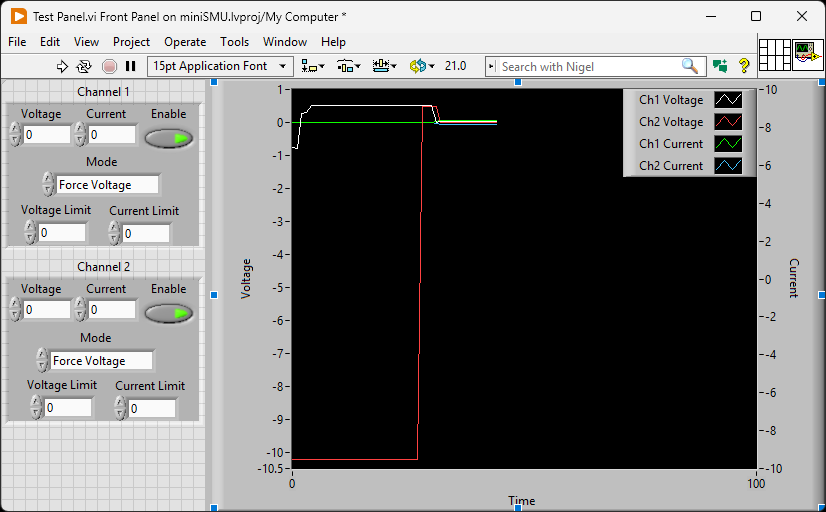
- Ready-to-run example panels: Test Panel, Streaming, and Sweep examples
- Type definitions for sweep config, streaming data, and JSON/CSV responses
- Full API reference documentation (PDF)
Requirements
- LabVIEW 2021 or newer
- NI-VISA with USB support
SweepMe!
Drive miniSMU from SweepMe! (the no-code measurement automation platform) and coordinate multi-instrument sequences without writing a line of code.
Supported features
- Full control of both SMU channels over USB or Wi-Fi
- FVMI and FIMV modes with programmable voltage & current compliance
- On-board I-V sweeps with up to 1000 points
- Configurable oversampling (OSR 0–15) for noise reduction
Great for
- Coordinating miniSMU with other lab instruments in one sequence
- Photovoltaic, semiconductor, and electrochemical characterisation
- Repeatable, automated measurement workflows with no scripting required